5
Magnetic attraction force
2026/1/15
In magnet applications, magnetic flux or magnetic flux density serves as an important indicator for evaluating performance, especially in motors.
Magnetic attraction force refers to the weight of ferromagnetic material that a magnet can adsorb.
It is jointly influenced by factors including the magnet’s properties, shape, size, and adsorption distance, and there is no mathematical formula available to directly calculate the attraction force of a given magnet.
Nevertheless, we can measure the magnetic attraction force using a dedicated testing device (typically by measuring the pulling force of the magnet and converting it to weight), as shown in the figure below.
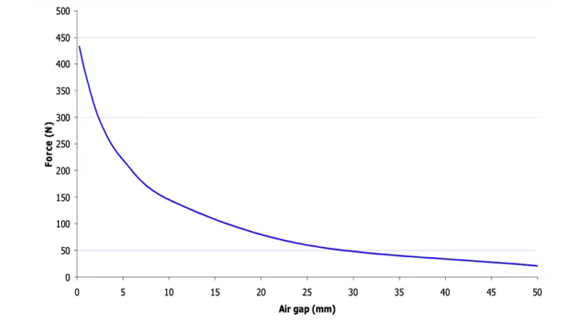
The attraction force of a magnet gradually decreases as the distance to the adsorbed object increases.

If you search online for magnet attraction force calculations, many websites state that "empirically, the magnetic force of an NdFeB magnet is about 600 times its own weight (some sources say 640 times)".
Is this empirical rule accurate? We can verify it through experiments.
In the experiment, sintered NdFeB N42 magnets of various shapes and sizes were selected, all with Ni-Cu-Ni plating and magnetized along their height direction.
The maximum pulling force (on the N pole) of each magnet was measured separately and converted into adsorption weight.
The measurement results are as follows:
It is obvious from the measurement results that:
The ratio between the weight a magnet can hold and its own weight varies greatly among different shapes and sizes. Some are less than 200 times, some exceed 500 times, and some can reach more than 3,000 times. Therefore, the online claim of 600 times is not fully accurate.
For cylinders or discs of the same diameter, the greater the height, the greater the weight they can hold; the attraction force is roughly proportional to the height.
For cylinders or discs of the same height (blue cells), the larger the diameter, the greater the weight they can hold; the attraction force is roughly proportional to the diameter.
For cylinders or discs of the same volume and weight (yellow cells) but with different diameters and heights, the weight they can hold differs significantly. In general, the longer the magnet is along the orientation direction, the stronger the attraction force.
Magnets with the same volume do not necessarily have the same attraction force; depending on their shape, the difference in attraction force can be substantial.
Conversely, magnets that can hold the same weight of ferromagnetic material may differ in shape, volume and weight.
For any shape, the length along the orientation direction plays the most decisive role in attraction force.
The above attraction force tests were conducted on magnets of the same grade.
We will carry out further tests to compare the differences in attraction force among magnets of different grades.
*Source: WeChat Official Account – Zhao Magic Magnets (找磁材)